Here’s a strange fact: most people understand other people better than they understand themselves.
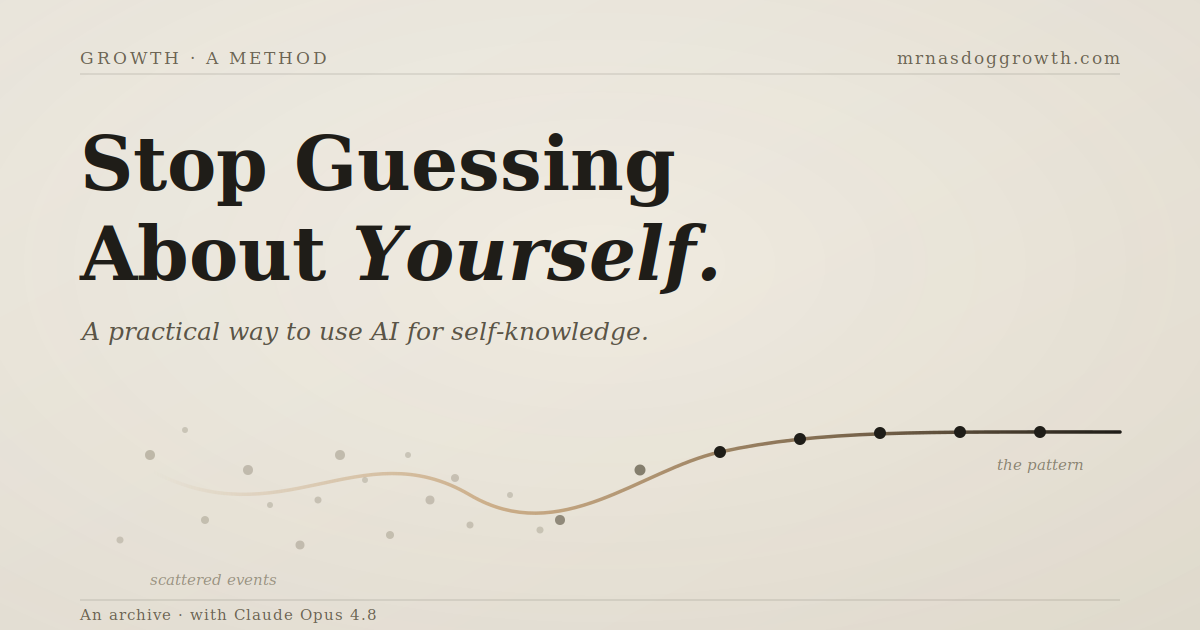
You can probably look at a friend and see their pattern clearly — “they always do this, they always avoid that.” But turn the lens on yourself and it goes blurry. You see events, not patterns. You remember what happened, but not the shape that connects it all.
This blind spot costs people years. They repeat the same mistake in different forms, blaming different causes each time, never seeing that it’s one mistake wearing different clothes. They fight against their own nature instead of building around it.
AI can fix this — if you use it right. Not by telling you what to do, but by helping you see the pattern you’re too close to see. I’ve done this on myself, and the result was something I’d genuinely missed for two decades. Here’s how the method works, so you can run it too.
I’ll point to Claude Opus 4.8 specifically. I’ve used most of the major models, and for reasoning carefully about a person’s history — holding a lot of context, going deep instead of generic — Claude is clearly the strongest. This method leans on that strength, so the model matters.
The core idea
The reason you can’t see your own pattern is simple. A pattern is only visible when you can see all its instances at once. Your memory stores your life as separate episodes, spread across years. You can’t hold them all in view simultaneously, so the thread connecting them stays invisible.
AI can hold them all at once. That’s the whole trick. You supply the raw material; the AI does what your memory can’t — sees the full set side by side and finds what repeats.
How to actually do it
First, tell it everything — honestly.
Write out your real history. Your projects, jobs, ventures, the things that worked and the things that crashed. For each, include what you thought the reason was at the time.
The honesty matters more than anything else here. If you feed it a polished, flattering version of your life, you’ll get a polished, useless answer back. The failures hold the most information. Don’t hide them.
Second, ask the right question.
Don’t ask “what should I do?” That gets you generic advice that fits no one.
Ask instead: “What’s the pattern? What do my wins have in common? What do my failures have in common? What’s the mechanism underneath?”
You want the AI working as a detective examining evidence, not as a cheerleader. The question you ask determines the kind of answer you get.
Third, refuse the first answer.
The first response is almost always the obvious one. Push back. “Go deeper. That’s surface-level. What causes that?” Keep pushing. The real insight tends to appear on the third or fourth round, after the easy answers are exhausted. Each push makes the AI reason harder instead of reaching for the convenient story.
This back-and-forth is where the value is. A single question gets you a single shallow answer. A real conversation — where you challenge each response — gets you somewhere new.
Fourth, test what you find.
When the AI proposes a pattern, check it against situations you didn’t mention. “If this is true, it should also explain that. Does it?” A real pattern explains cases it wasn’t built from. A fake one only fits the examples you gave it. This is your reality check.
What you do with the answer
Here’s the part to be clear about. AI can show you the pattern. It can’t live your life.
It can tell you how you’re built — where you’re strong, where you reliably fail, what conditions bring out your best. It cannot tell you what to want, what to value, or what kind of life is worth living for you. Those are yours alone.
So split the process in two. Use AI for the seeing — the clear, honest map of how you operate. Then do the choosing yourself. The map tells you the terrain. Where you decide to walk is up to you.
When I ran this on myself, the pattern I found explained both my successes and my failures with a single mechanism I’d never noticed. It didn’t tell me what to do — but once I could see it, the right direction became obvious. That’s the typical experience: the seeing makes the choosing easy, even though the seeing and the choosing are different acts.
The honest limits
Three things this won’t do.
It won’t know what you don’t tell it. Honesty in equals insight out; dishonesty in equals confident nonsense out.
It won’t predict your future with certainty. It works from your history, and the future isn’t fully written by the past. It shows you tendencies, not guarantees.
It won’t give you values. It maps your strengths. It doesn’t decide what those strengths are for.
Why it’s worth an hour of your time
Most people operate on a vague, slightly flattering, partly false story about who they are. They make big life decisions based on that story. When the story is wrong, the decisions are wrong, and they don’t find out for years.
Replacing that fuzzy story with an accurate map — even one that stings a little — might be the highest-return hour you can spend. You stop fighting your own nature. You stop repeating the invisible mistake. You start building on what actually works for you.
You already have the tool. You already have the history. All you have to do is sit down, be honest, and ask the right questions. The pattern is in there. You just need something that can hold it all at once and help you see it.